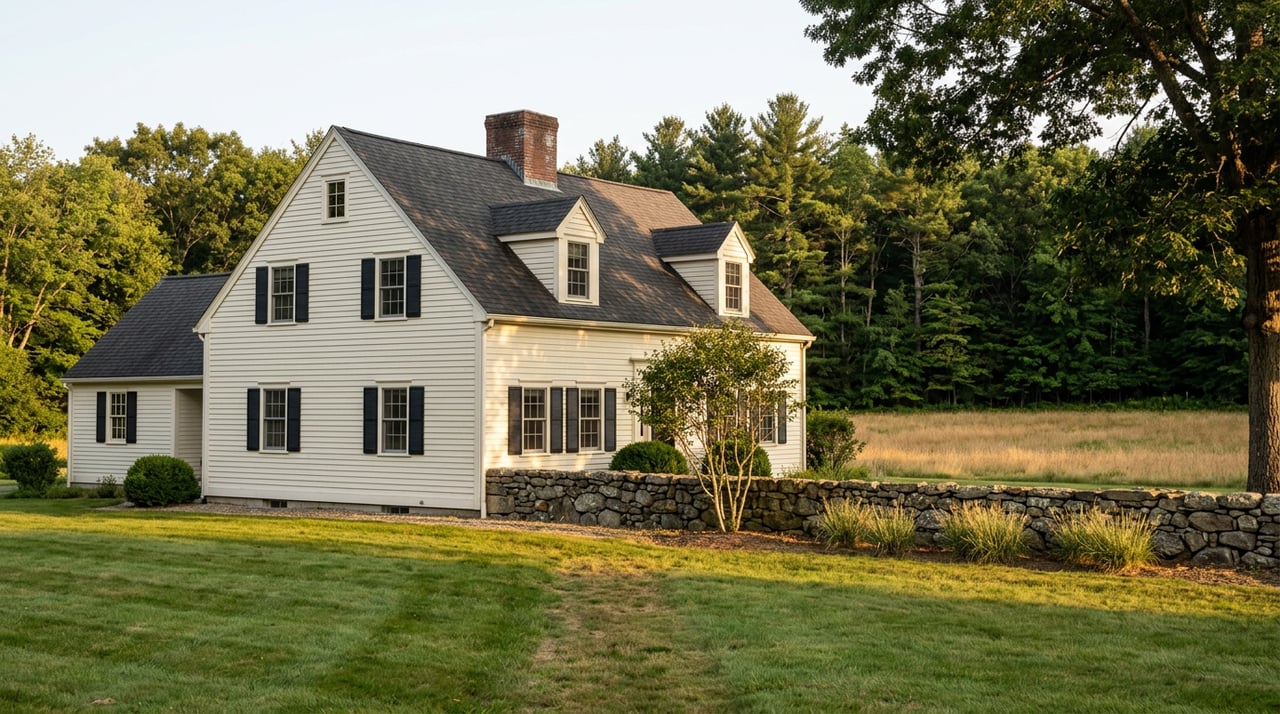
A buyer falls for a lot on a back road in West Newbury: three acres, a stand of white pine, a stone wall that has probably marked that boundary since before the Revolution. The offer gets accepted within a week. Then the listing agent mentions, almost in passing, that the parcel is enrolled under a state tax program, and the town now has 120 days to decide whether it wants to buy the land instead.
That clock is not a formality. It is written into Massachusetts General Law, it has been fought over in court between a nearby city and a landowner, and it explains a good part of why West Newbury's open, rural feel does not translate into open, rural inventory the way the acreage numbers suggest. Buyers comparing this town to Newbury, Newburyport, or the rest of the North Shore tend to read "more land for the money" as a straightforward trade. It is not. Much of that land carries conditions that only surface once you are already under contract.
Three acres does not mean three buildable acres
Start with zoning. Outside the village center, West Newbury generally requires two-acre minimum lots. Closer to Main Street and the Merrimack River, the minimum drops to a half-acre or an acre. That split alone means a ten-acre parcel on the outskirts of town and a ten-acre parcel near the river center can carry very different development math, even before anything else about the land is considered.
Then add the town's Open Space Preservation Development bylaw. Any subdivision that creates three or more lots can be required to keep at least 60 percent of the parcel as permanent open space under a conservation restriction, rather than releasing it for house lots. The town's 2026 Community Preservation Plan credits this bylaw with preserving 64 acres across four subdivisions alone: Kimball Road Extension, Ocean Meadow, Cottages at River Hill, and Drake's Landing. A buyer looking at a large, wooded lot and mentally sketching a future subdivision should ask, early, whether that math already assumes 60 percent of the land is off the table.
| Zoning tier | Minimum lot size | Where it applies |
|---|---|---|
| Outlying / rural areas | 2 acres | Most of the town outside the village center |
| Main Street corridor | 0.5 to 1 acre | Near the village center |
| River corridor | 0.5 to 1 acre | Along the Merrimack River |
The tax break that comes with a string attached
Separate from zoning, a meaningful share of West Newbury's open land is enrolled under Massachusetts Chapter 61, 61A, or 61B. These programs let landowners pay property taxes based on the land's current use as forest, farmland, or recreational open space rather than its potential development value. Chapter 61 forest land needs at least 10 contiguous acres under a 10-year state-certified management plan. Chapter 61B recreational land needs at least 5 contiguous acres. In exchange for the lower tax bill, the town keeps a hand on what happens next.
When a landowner in one of these programs wants to sell for, or convert to, residential, commercial, or industrial use, state law requires certified-mail notice to the Select Board, the Assessor, the Planning Board, the Conservation Commission, and the State Forester. That notice starts a 120-day window during which the town can match a bona fide offer and buy the land itself, or assign that right to a land trust or conservation group. If the town assigns the option, at least 70 percent of the land has to stay in qualifying open, agricultural, or recreational use under a permanent deed restriction, and the assignee cannot develop more of the land than the original buyer proposed.
There is also a financial penalty for changing course. If enrolled land is sold or converted within its first year out of the program, the conveyance tax runs 10 percent of the sale price. That rate steps down by a point each year until it disappears after ten years. Chapter 61B land follows a similar but steeper curve: 10 percent if sold within the first five years, 5 percent between years six and ten, nothing after that. A landowner can also withdraw from the program without a penalty if the land's use stays the same for at least five years afterward, and family transfers, such as passing land to a child or grandchild who intends to build a home there, are generally exempt from the town's right of first refusal altogether.
None of this is theoretical for this stretch of the North Shore. In 2005, a landowner notified the neighboring city of Newburyport of her intent to sell agricultural land enrolled under Chapter 61A. Newburyport argued the accepted purchase and sale agreement was not a genuine bona fide offer because it was loaded with contingencies tied to an unpredictable affordable-housing review process, and a Land Court judge agreed enough to block the sale while the case worked through the courts. The legislature later amended the statute specifically to close that loophole. The dispute is a matter of public record, and it is the clearest local proof that the 120-day clock is a real constraint on a real transaction, not paperwork that gets waived at closing.
What "protected" has already meant here
Two farms make the pattern concrete. Brown Spring Farm, a 10-acre roadside property known for its produce stand, was permanently protected in 2019 through a Buy-Protect-Sell arrangement between the town and Greenbelt, the regional land trust. The town and Greenbelt purchased an agricultural preservation restriction on the land using $200,000 in Community Preservation Act funds along with $203,500 in private donations, which lowered the purchase price enough for farmer Chris Grant to buy and keep the land in production rather than losing it to development pressure. Evergreen Farm, a former Christmas tree farm, followed in 2024 when 32 acres of wildlife habitat, farmland, and forested upland were conserved, with a restriction placed on part of the property.
These are not edge cases. They are the town's stated method for handling land that comes up for sale in a place that has spent three decades approving open-space and conservation warrant articles at Town Meeting. A buyer who assumes an open field will eventually be a buildable lot is betting against a pattern the town has repeated for years.
The bylaw that shows up in the disclosure packet
There is one more piece of paperwork worth knowing about before you write an offer near active farmland. In 2025, West Newbury created an Agricultural Committee under its Right to Farm bylaw.
Normal farming activity in West Newbury may involve noise, odors, dust, and fumes, and a disclosure notice describing that reality is required when a property near active farmland is sold or occupied.
That is not a warning about a problem. It is the town formally protecting its working farms from complaints by new neighbors, and it means a buyer touring a pretty pasture-view property should expect the disclosure and read it as confirmation of what the land around it is actually used for, not an unusual red flag.
Reading the wider market against this backdrop
Statewide, the picture in mid-2026 has been loosening. The Massachusetts Association of Realtors reported that new listings for single-family homes rose 10.7 percent year over year in June 2026, and closed sales jumped 7 percent, even as the statewide median single-family price eased slightly to $715,000 from $725,000 the year before. That is a market where inventory is catching up and buyers are gaining a little room to negotiate.
West Newbury does not necessarily move with that current, because its supply constraint is not primarily about sellers holding back. It is structural. Zoning minimums, the 60-percent open-space requirement on qualifying subdivisions, and a real share of acreage sitting inside Chapter 61 programs all cap how much of the town's land can turn into house lots regardless of what buyers want to pay for it. A buyer treating West Newbury as "Newburyport with more land for less money" is comparing the wrong variable. The land is not simply cheaper. Much of it is legally spoken for in ways that a median price per acre cannot show.
A short, practical checklist
- Ask whether the parcel, or any abutting parcel that affects setbacks and views, is currently enrolled under Chapter 61, 61A, or 61B.
- If it is, ask how long it has been enrolled and where it sits on the conveyance tax curve.
- Ask whether the subdivision or parcel is subject to an Open Space Preservation Development special permit, and if so, how much of the total acreage is already restricted.
- Near working farms, expect and read the Right to Farm disclosure rather than treating it as a warning sign.
- Loop in a real estate attorney early if a Chapter 61 notice has been filed. The 120-day window moves on its own schedule and does not wait for a typical closing timeline.
FAQ
Does every large lot in West Newbury carry a right of first refusal? No. The right of first refusal only applies to land currently enrolled under Chapter 61, 61A, or 61B. Plenty of large, unrestricted lots exist outside those programs, which is exactly why it is worth asking the question directly rather than assuming based on acreage alone.
Can a buyer purchase Chapter 61 land and keep it in agricultural use? Yes, and doing so can avoid triggering the town's right of first refusal and the associated conveyance tax, since the notice requirement is tied to a change in use rather than to ownership changing hands on its own.
Does the Open Space Preservation Development bylaw apply to every subdivision? It generally applies once a project creates three or more lots or units. Smaller splits may not trigger the same open-space requirement, which is another reason the exact parcel history matters more than the listing description.
Land in West Newbury rewards patience and a close read of the paperwork behind it more than almost anywhere else on the North Shore. If you are comparing this town against Newburyport, Newbury, or Plum Island and want a straight answer on what a specific parcel's zoning, conservation status, or Chapter 61 history actually means for your timeline, Rick Zaniboni and the team can walk the parcel history with you before you write an offer. Book an appointment to talk through what a specific property's restrictions mean for your plans.